
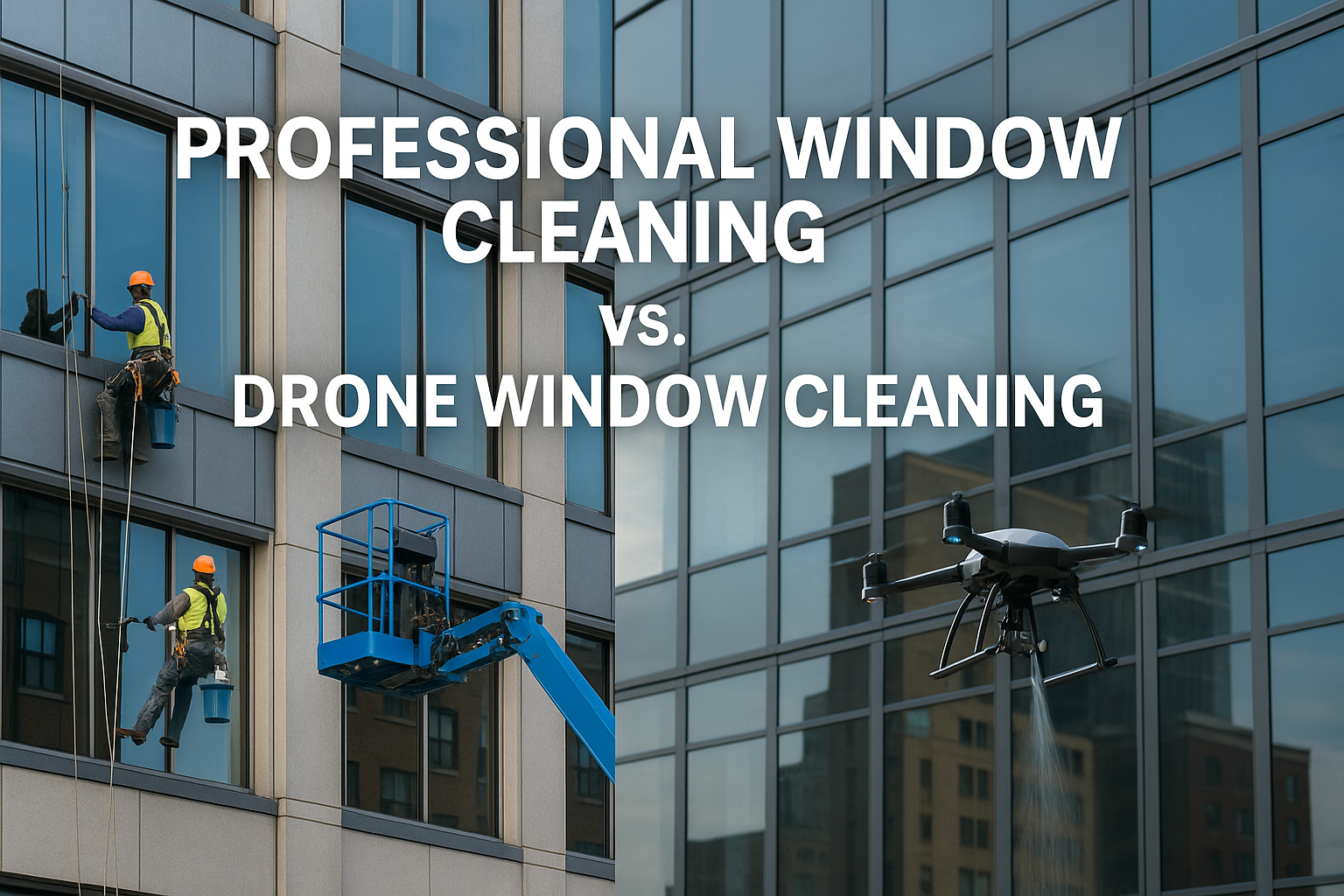
Is Newer Always Better for Commercial Window Cleaning?
With drone technology making headlines, many commercial property owners are starting to ask a fair question: If drones can clean windows remotely, do we still need professional window cleaning crews on site? It’s a smart question—especially when safety, cost, and efficiency are always top priorities in managing commercial buildings.
At Ascent Building Service, we work with commercial properties across Chicago, Indianapolis, Milwaukee, Kansas City, St. Louis, Naperville, and Arlington Heights. We’ve seen new technologies come and go, and we’ve also seen what actually works in real, occupied commercial environments.
Below, we break down the five key advantages of professional window cleaning compared to drone window cleaning, so you can make a decision based on results—not marketing buzz.
Understanding the Two Approaches to Window Cleaning
Before comparing advantages, it helps to understand how these two methods differ in practice.
Professional window cleaning relies on trained, insured technicians using proven equipment, safety systems, and site-specific procedures. For commercial properties, this often includes lift systems, rope access, water-fed poles, and strict safety protocols tailored to each building.
Our teams deliver consistent, streak-free results while working safely around employees, tenants, and pedestrians. Learn more about how professional window cleaning fits into a complete approach to building care in our guide to commercial property maintenance solutions
This is why many of our clients rely on our dedicated commercial window cleaning services as part of their ongoing building care strategy.
Drone window cleaning, on the other hand, uses remotely operated drones equipped with spray systems or brushes. While the technology is innovative and visually impressive, it is still developing—and its real-world limitations become clear when applied to complex commercial properties.
Professional Window Cleaning vs Drone Window Cleaning at a Glance
This side-by-side snapshot breaks down the key differences between professional window cleaning and drone window cleaning, helping you quickly understand which approach works best for commercial buildings.
| Key Evaluation Area | Professional Window Cleaning | Drone Window Cleaning |
|---|---|---|
| Safety & Liability Control | Trained, insured crews follow OSHA-aligned safety procedures with on-site supervision and controlled risk management. | Higher safety uncertainty due to potential signal loss, wind instability, and falling equipment in active commercial areas. |
| Cleaning Precision & Finish Quality | Delivers consistent, streak-free results with detailed attention to glass, frames, edges, and buildup. | Often limited to surface rinsing and may struggle with stubborn residue, frames, and detailed finishes. |
| Cost Transparency & Long-Term Value | Predictable pricing and reliable service schedules support long-term maintenance planning for commercial buildings. | Costs may fluctuate due to operational limits, rework needs, and inconsistent results. |
| Regulatory & Insurance Readiness | Fully aligned with commercial compliance requirements, insurance coverage, and documented safety protocols. | Operates in evolving regulatory environments that may restrict use on many commercial properties. |
| Site-Specific Adaptability | Adapts to different building heights, layouts, weather conditions, and occupancy levels across Midwest cities. | Performance can be limited by wind, tight spaces, complex architecture, and surrounding activity. |
Advantage #1: Stronger Safety and Liability Control
Safety is the first concern for any commercial property manager, and it’s one of the biggest differences between professional window cleaning and drone window cleaning.
With professional window cleaners, safety is planned, documented, and actively managed on site. Crews are trained to follow OSHA-aligned procedures, assess building conditions, control ground-level risk, and adjust in real time to weather or site activity. This hands-on accountability significantly reduces liability exposure for property owners.
Drone window cleaning introduces different safety risks. Drones can malfunction, lose signal, or become unstable in wind—especially around high-rise buildings common in downtown Chicago, Milwaukee, and St. Louis. A falling drone poses serious risk to people, vehicles, and property below, shifting liability concerns back to the building owner.
According to Occupational Safety and Health Administration (OSHA), falls and struck-by incidents remain leading causes of workplace injuries, which is why controlled, human-supervised safety systems remain the standard in commercial exterior maintenance.
This is one reason professional window cleaning continues to be the safer choice for occupied buildings.
Advantage #2: Superior Cleaning Precision and Consistent Results
Clean windows are about more than removing surface dust—they’re about consistency, clarity, and long-term appearance.
Professional window cleaning delivers detailed results because trained technicians can adapt their approach to glass type, frame condition, seals, and buildup. Edges, corners, frames, and residue are addressed properly, not skipped.
This matters for storefronts, office towers, medical buildings, and multi-tenant properties where appearance reflects directly on the business inside.
Drone window cleaning is far more limited in this area. While drones can rinse glass, they often struggle with stubborn buildup, bird droppings, mineral stains, or uneven surfaces.
This raises an important question many people ask: Is drone window cleaning effective for high-rise buildings? In controlled, low-detail situations, it can help—but it rarely matches the finish quality expected for professional commercial properties.
Advantage #3: Clearer Cost Structure and Long-Term Value
When comparing professional window cleaning vs drone window cleaning cost, it’s important to look beyond initial pricing.
Professional window cleaning offers predictable pricing based on building size, access method, and service frequency. This allows property managers to budget accurately and plan maintenance schedules without surprises. More importantly, consistent professional cleaning helps protect glass and frames over time, reducing long-term repair or replacement costs.
Drone window cleaning often appears cost-effective upfront, but costs can rise quickly due to equipment limitations, restricted operating conditions, and inconsistent results that require follow-up services. For commercial buildings that need reliable, repeatable results, professional window cleaning remains the more cost-stable solution.
Advantage #4: Regulatory Compliance and Insurance Readiness
Commercial properties operate under strict regulatory and insurance expectations, and this is where professional window cleaning has a clear advantage.
Professional window cleaners operate within established safety, labor, and insurance frameworks. Crews are insured, trained, and accountable, which aligns with the compliance requirements most commercial buildings must meet. This is especially important for properties with corporate tenants, healthcare facilities, or public access.
Drone window cleaning, while innovative, exists in a more complex regulatory space. Airspace restrictions, local ordinances, and evolving safety guidelines can limit where and how drones are legally operated. For many property managers, this uncertainty alone makes drones a risky primary solution.
Advantage #5: Site-Specific Adaptability Across Commercial Properties
No two commercial buildings are the same—and professional window cleaning is designed for that reality.
Our teams adapt to building height, façade materials, surrounding foot traffic, and regional weather patterns. Whether it’s wind conditions in downtown Chicago, mixed-use properties in Naperville, or industrial buildings in Kansas City, professional window cleaners can adjust methods on site to deliver safe, effective results.
Drone window cleaning is far less flexible. Wind, tight spaces, architectural details, and reflective surfaces can all limit drone effectiveness. For commercial properties that demand adaptability, professional window cleaning remains the more reliable option.
Where Drone Window Cleaning Can Make Sense
Drone window cleaning does have situational value. In limited, controlled environments—such as inaccessible surfaces or inspection support—drones can complement traditional services. However, they are not yet a replacement for professional window cleaning when safety, finish quality, and compliance matter.
We view drones as a developing tool, not a complete solution.
Why Professional Window Cleaning Remains the Commercial Standard
Professional window cleaning continues to be the preferred choice because it integrates seamlessly into broader building care. Clean windows are not an isolated task—they’re part of a complete exterior and interior maintenance strategy.
That’s why many clients include window cleaning within their overall commercial property maintenance plans, ensuring consistent appearance, safety, and long-term value.
Choosing What Works for Your Building
New technology always brings new possibilities, and drone window cleaning is no exception. But when it comes to commercial buildings, proven performance still matters most.
Professional window cleaning delivers stronger safety control, better results, predictable costs, regulatory compliance, and site-specific adaptability—advantages that drones can’t yet match.
If you’re evaluating the best approach for your commercial property, choosing a professional window cleaning solution means choosing reliability, accountability, and long-term value.
If you’re ready to protect your building’s appearance and safety with a proven approach, request a quote from our team today to see how professional window cleaning fits your property’s needs.
Frequently Asked Questions
Is drone window cleaning effective for high-rise buildings?
Drone window cleaning can assist in limited scenarios, but it often struggles with precision, wind conditions, and detailed cleaning on high-rise structures.
What are the main drone window cleaning safety risks?
Loss of control, falling equipment, and limited real-time hazard management are the most common concerns.
How does professional window cleaning vs drone window cleaning cost compare?
Professional window cleaning offers more predictable pricing and long-term value, while drone costs can fluctuate due to operational limits.
Can drones replace professional window cleaners for commercial buildings?
At this time, drones work best as a supplemental tool—not a full replacement for trained professionals.
Why do most commercial buildings still choose professional window cleaning?
Because it provides consistent results, stronger safety controls, and compliance-ready service for occupied properties.
